Precast vs Cast-in-Place: What's Right for Your Irrigation Infrastructure in the Riverina?
When it's time to install or replace outlets, headwalls, dropboxes, or channel structures, the choice between precast and cast-in-place comes down to timing, water integrity, and how much disruption you can afford during a working season.
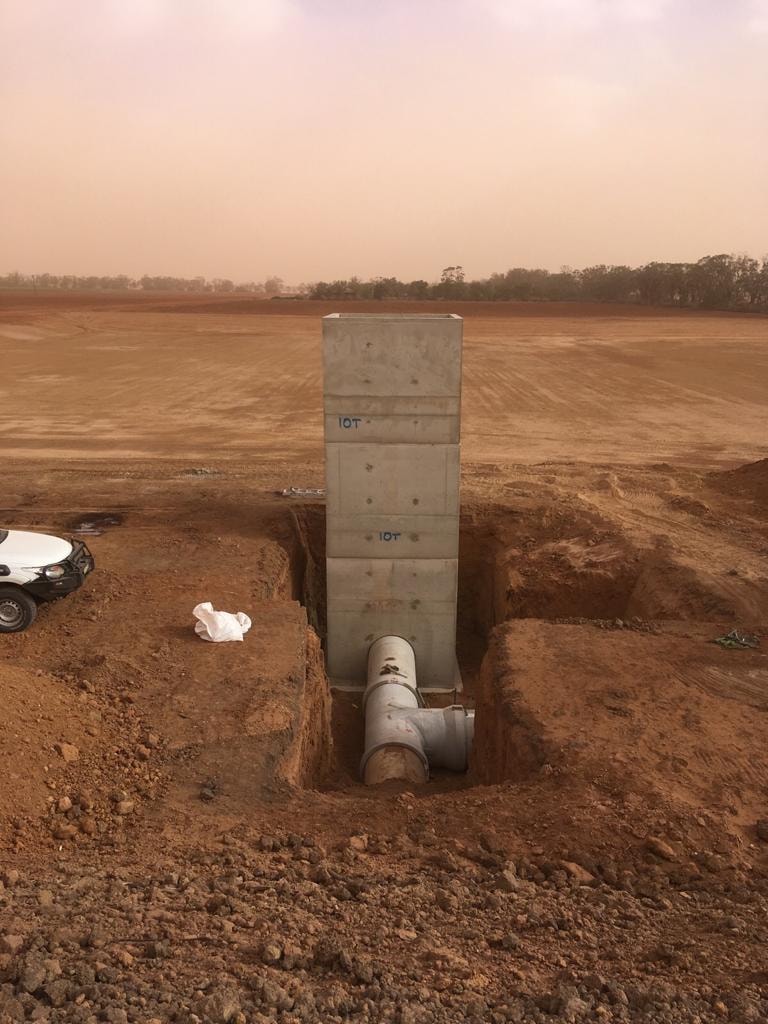
When it's time to install or replace outlets, headwalls, dropboxes, or channel structures on a Riverina property, one of the first decisions is how the concrete gets made — precast off-site and installed, or cast-in-place on your paddock. Both approaches have a place in irrigation infrastructure, and the right choice usually comes down to timing, water integrity, and how much disruption you can afford during a working season.
Here's how they compare on the factors that actually matter for irrigation work.
Installation Time
Cast-in-place requires formwork to be built on-site, concrete poured, and then a curing period before the structure can be put into service — often a week or more depending on conditions. That's time your channel or bay is out of action.
Precast structures are manufactured off-site and cured before they ever arrive on your property. Installation is typically a matter of hours, not days — the unit is delivered, placed, and connected. For growers working around a cropping calendar or an irrigation season that won't wait, this difference alone often settles the decision.
Water Integrity
Irrigation structures live or die on how well they hold water. Cast-in-place work is only as consistent as the conditions on the day — weather, site access, and the pour itself all introduce variability, and construction joints are a common point of long-term seepage.
Precast units are manufactured in controlled factory conditions, which means consistent concrete quality and, where a structure allows, one-piece pours with no construction joints. Fewer joints means fewer places for water to find its way out over the life of the structure.
Customisation vs Standardisation
This is where the two approaches genuinely differ in philosophy rather than just process.
Cast-in-place is built to fit whatever the site demands, shaped and formed on the spot. That flexibility comes at the cost of time and consistency.
Precast can match that flexibility without losing the speed and quality advantage — but only if the manufacturer has the mould range to back it up. This is where scale matters: with 200+ proprietary moulds built up over three decades of supplying the Riverina, we're able to match precast structures to a very wide range of channel sizes, flow requirements, and site conditions without defaulting to a fully custom (and slower) pour. Where something genuinely doesn't exist in the range, we design and manufacture to order.
Cost Over the Life of the Structure
Cast-in-place can look cheaper upfront in some cases, particularly for genuinely one-off, unusual geometries. But irrigation infrastructure needs to perform for decades, largely unattended, in conditions that aren't forgiving of weak points. Precast's manufacturing consistency tends to show up as a lower total cost over the structure's working life — less maintenance, less repair, fewer seepage losses to chase down.
What We've Seen Work Across the Basin
Having supplied irrigation infrastructure across the Riverina and southern Murray-Darling Basin for over 30 years — including Murray Irrigation district works and thousands of individual farms — the pattern is consistent: precast wins on turnaround and long-term water integrity for the vast majority of standard and semi-standard irrigation structures. Cast-in-place still has a role for genuinely unique, one-off site conditions where nothing off-the-shelf, or from an established mould library, will do the job.
Making the Right Call for Your Property
The right answer depends on your specific site, timeline, and flow requirements. If you're weighing up options for an upcoming project, get in touch with our team — we can talk through what's worked for similar properties and channel conditions across the region.
Milcast Australia manufactures precast concrete irrigation and civil infrastructure from Finley, NSW, backed by 200+ proprietary moulds and over 30 years supplying the Murray-Darling Basin.
Explore Topics
Written by
Milcast Team
Content creator and writer sharing insights and stories.


